MBQ1

Draft notice: This website is under development and currently serves as a draft landing page for the HSC-Niji survey.
Mapping the Universe through medium-band colors
A new medium-band imaging survey with Hyper Suprime-Cam on the Subaru Telescope, designed to investigate key questions in cosmology, galaxy evolution and AGN, Galactic archaeology, stellar and planetary science, and calibrate photometric redshift estimates in Stage IV surveys.
Niji means “rainbow” in Japanese: a survey identity built around the idea of decomposing the optical-to-near-infrared sky into 16 colors, to unveil the physical processes that shape galaxies, black holes, and the large-scale structure of the Universe.
HSC-Niji combines the wide-field capability of Hyper Suprime-Cam with medium-band quasi-spectral information, bridging broad-band imaging and spectroscopy. The survey is designed to improve photometric redshifts, detect emission-line populations, select rare objects, and connect galaxies and active black holes to their environments.
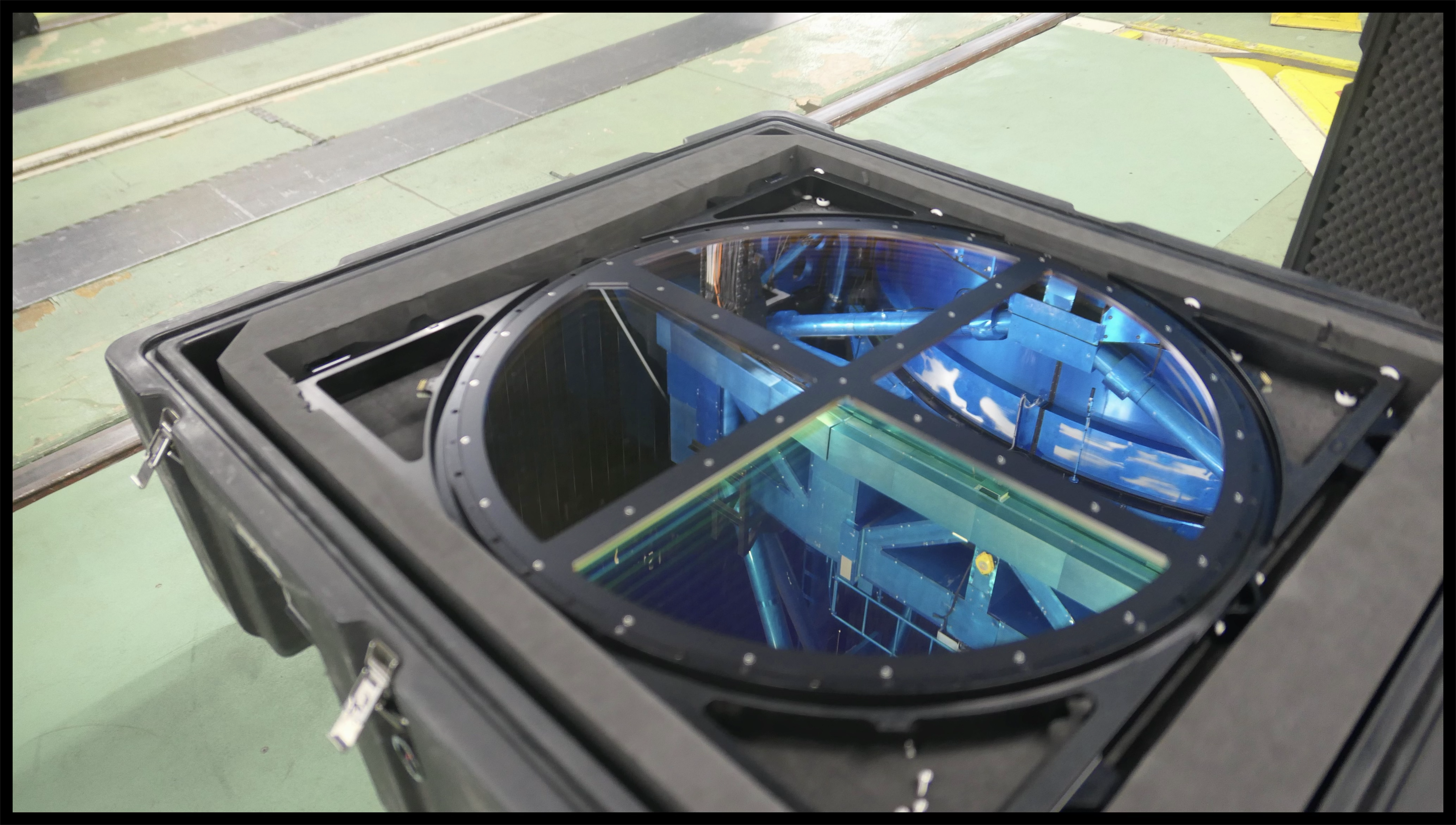
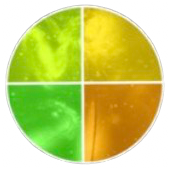
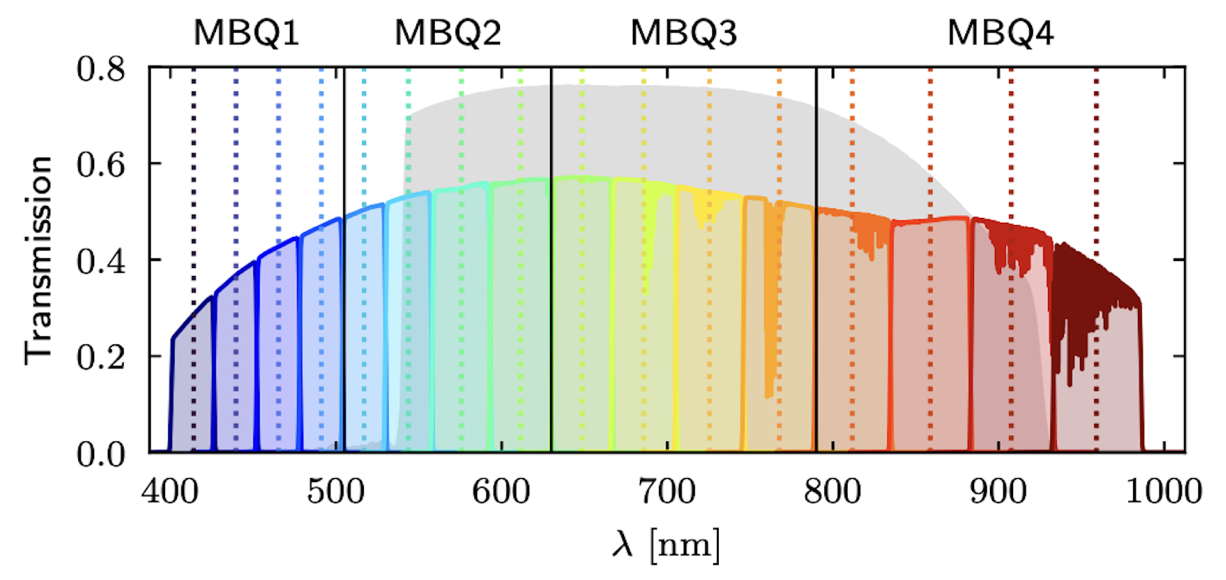
Sixteen medium-band filters organised in four telescope quadrants (MBQ1 to MBQ4) provide low-resolution spectra, enabling sharper physical interpretation than broad-band colors alone.

HSC-Niji is designed as an interdisciplinary platform spanning cosmology, photo-z, AGN, galaxy evolution, clusters and large-scale structure, Galactic archaeology, and stellar and planetary science.
Use precision colors, weak-lensing information, and cross-correlations to constrain the evolution of the Universe.
Resolve medium-band spectral features to improve redshift precision and reduce catastrophic outliers.
Select active galactic nuclei and investigate black-hole growth, dual AGN, mergers, and their environments.
Trace galaxy growth, star formation, quenching, morphology, and environment across cosmic time.
Map galaxy clusters, large-scale structure, and the environmental processes connecting galaxies across the cosmic web.
Reconstruct the Milky Way’s assembly history through its stellar populations, chemistry, and Galactic structure.
Study stellar populations and planetary-system science through consistent, information-rich multiband imaging.
Workshop information and material connected to the HSC medium-band survey program and the broader HSC-Niji science community.
Stay tuned for updates on observing status, future data-release plans, catalog descriptions, access policy, and collaboration information.
Medium-band observations, image quality information, depth maps, and survey footprints.
Photometry, source measurements, emission-line candidates, and selected science-ready samples.
Photometric-redshift products, selection functions, simulations, validation samples, and documentation.
HSC-Niji represents a collaborative framework across international surveys and observational facilities.
For questions about science projects, workshops, and collaborations related to the HSC-Niji survey, please contact the HSC-Niji coordinators.